


BOOK CULTURE

The historiographical tradition of studying reading in Russia started in 1890s and was interrupted in 1930s. When book studies got the status of a scientific discipline in the late 1950s, this issue appeared on the pages of professional collections and periodicals. That’s why the reactualization of scientific heritage is of heuristic value. Thanks to the sources introduced into scientific circulation, the developed methods for their interpretation, it is necessary to develop directions for future research. The article provides a quantitative and qualitative analysis of publications in the collections “Book. Research and materials” in 1959–1991, devoted to the history of reading. Using statistical and analytical methods it identifies the main subject fields and vectors of research. The historiographical review of the materials in the mentioned collections with the rationale for their periodization has been previously made. The novelty of this study lies in the choice of the subject matter – the history of reading in Russia. Of 1 193 articles in 63 collections 354 (30 %) ones have been selected for analysis on the research topic. The results show the great attention of Russian book critics to the “external history of reading” (56 % are articles on publishing houses, circulations, subscribers, and prices of printed products), and they are less interested in the “internal history of reading” (29 % are individual readers’ biographies and practices of political and cultural figures). The interest in the topic was not linear, it had a polynomial trend line. The topic chosen for the analysis has revealed the confrontation between Moscow and Leningrad schools of book studies. In the main collection of Soviet book critics, theoretical debates on the methodology of studying reading have not lead to the development of a unified concept.
The results of the study are presented in two parts. The first one provides the ideology of the research, general quantitative data and analysis of articles on the methodology of reading studies. The second one (it will be published in the next issue) describes reading practices and materials with reference to information and facts on readership, circulation, costs, etc., as well as general conclusions. They can be used in the future, since the history of reading is a promising area for studying book communicative function and its role in the history of culture.
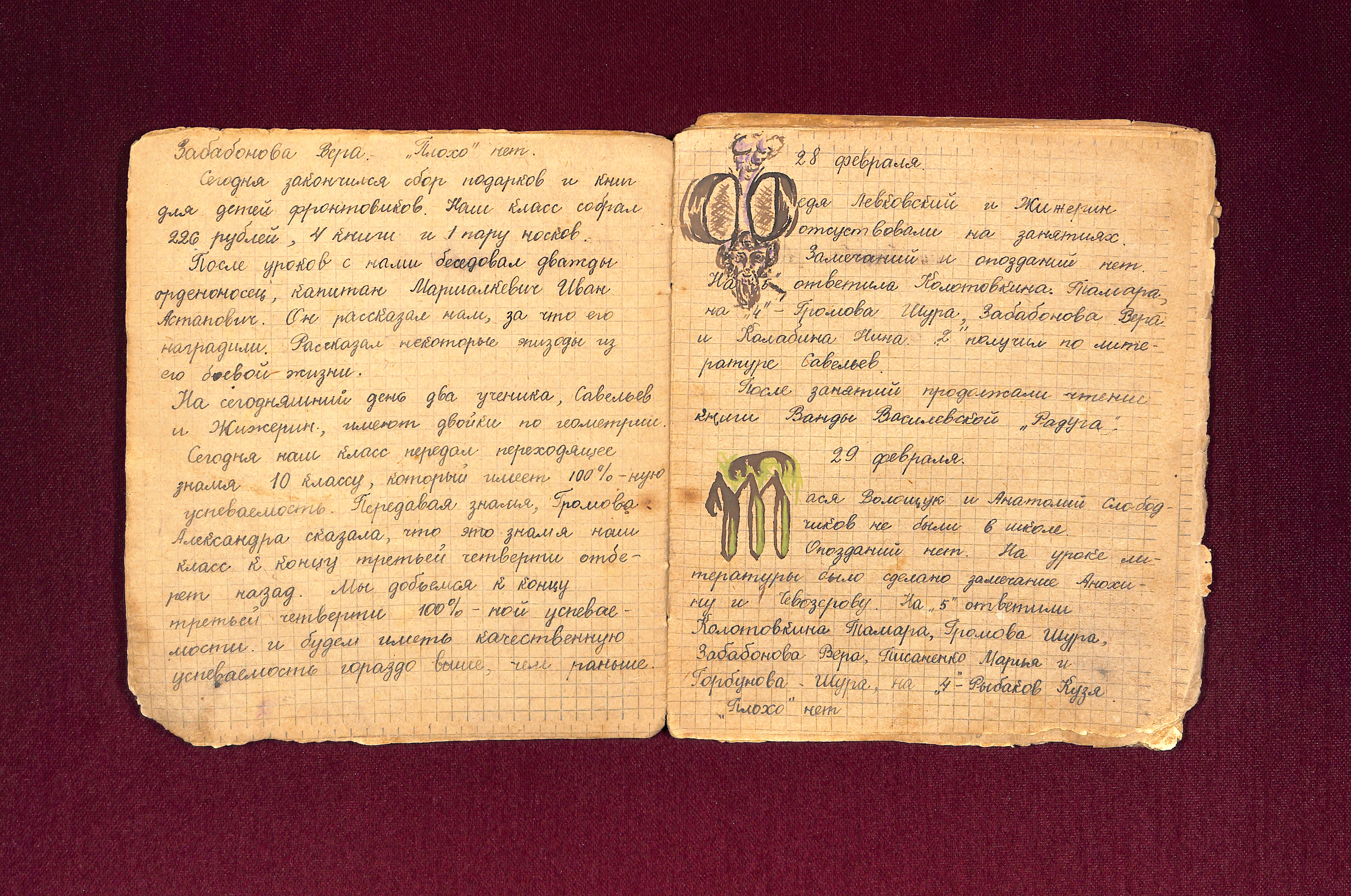
The relevance of the article is due to its reference to the microhistory and history of childhood in the context of the theory of cultural memory and the use of an appropriate conceptual framework to analyze a local historical source associated with Western Siberia during the Great Patriotic War. The purpose of the article is based on the material of a diary kept by schoolchildren in Bolotnoye (Novosibirsk region) in 1944–1945, to identify problematic points of reading and studying the collective ego document and demonstrate the prospects of working with it via the categories “subject”, “recipient”, “recognition group”, “identity”. The main result of the research is the manifestation of the reflexive layer contained “behind the text” of Bolotninsky Diary: the authors’ motives are clarified and their chosen strategies for constructing a collective identity are defined. In one case, it is aimed at integrating the class into a more global community of “Soviet people”, in the other one, it is a self-awareness as an integral community belonging to the world of childhood. The practical significance of the research lies not only in the scientific development of a specific source on the history of everyday life, but also in testing the methodology of collective diary research, which can be used later in the study of similar documents.
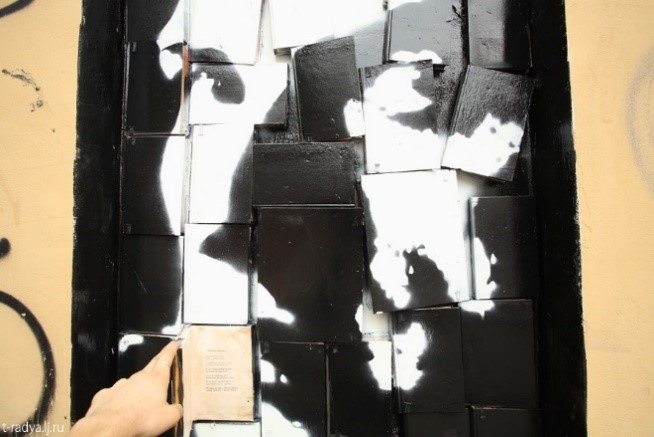
Electronic and audio books have not replaced paper ones, but have updated them in a new way; that’s why books about books are becoming a noticeable trend. Its features are examined using the example of two recent publications: “The Book as an Illusion” by Yulia Shcherbinina and “Portable Magic” (“Notes of a Bibliophile” in Russian) by Emma Smith. First, the trend itself is characterized: its expansion with the claim to be “mainstream”, the use of the resource of a broader trend of “coziness”, the spread of book-related activities, including specialized blogging. Then, by comparing the works of E. Smith and Yu. Shcherbinina, the key points of the current agenda of the problematization of bookishness are analyzed: firstly, the status of materiality and, secondly, the activity of the owner or user of the book, including the not always obvious division of all book-related practices on reader’s and non-reader’s ones. To describe bookishness, the concept of book social competence is introduced, which is extended to modern book infrastructure and practices.
During the study of the role of the Cyrillic book in the spread of Christian culture in the Middle Volga region after its annexation to the Russian state in the middle of the 16th century, book copies significant for the history of the city of Samara and surrounding settlements were identified, created or located in this region during the 17th century. These are the oldest books related to Samara land. Overwhelmingly, they relate to liturgical literature. Some of them have been the subject of consideration in our individual articles. This article provides a generalized overview of them. The sources of information about the book resources of interest and the methodology of their search are described. The relation of books to the territory and epoch under consideration is marked by marginal book entries and accompanying texts, their contents also provide valuable information about various persons, including residents of Samara, settlements, churches and monasteries. The article attempts to estimate the number of books in circulation in the Samara region by the end of the 17th century. It has been found that today there is information about 10 % of the copies of this number, 6 volumes have survived to our time and are in various book depositories of the Russian Federation, having the status of book monuments. More than the half of the identified books are created in the first half of the 17th century, before the church reforms of Patriarch Nikon; this this phenomenon is explained by the need for Old Believers to preserve ”pre- Canonical” books. The sample itself, obtained as a result of the study, is representative in certain aspects: it can be used to assess the book repertoire of the region, the ratio of handwritten and printed books.
The article presents a source critical overview of published ego-documents on the Russian–Japanese War of 1904–1905 that are recorded in the Nauchnaya Sibirika database of the State Public Scientific and Technical Library of the Siberian Branch of the Russian Academy of Sciences (SPSTL SB RAS). Basing on E. V. Kodan’s three- aspect methodology (informational, biographical, and communicative analysis), it examines a corpus of 42 publications (19 memoirs, 17 diaries, and 6 collections of letters). The article focuses not only on genre typology but also on the critical assessment of the corpus’s representativeness within the chosen source database. It shows that different strategies of narrative construction (post-factual rationalization in memoirs, the sociolinguistic specificity of diaries, and filtering mechanisms in the publication of letters) require different approaches to source critical analysis and interpretation. It is demonstrated that memoirs tend to shift reconstruction toward diachronic reflection, whereas diaries and letters provide access to a synchronic perspective of the war. Despite the corpus’s limitations, the identified set of sources establishes reference points for further in-depth analysis of the personal dimension of the Russian- Japanese War and makes it possible to refine existing historiographical approaches to interpreting this conflict.
LIBRARY WORLD
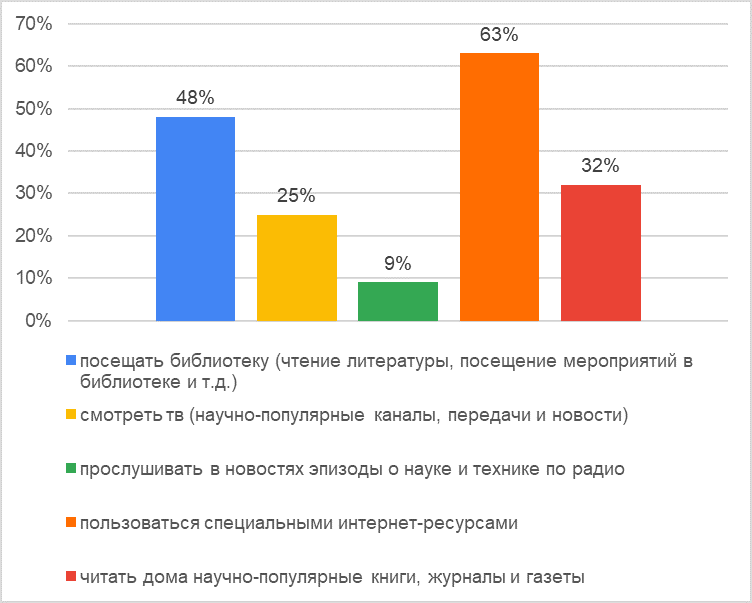
One of the most important functions of the library remains the dissemination of new knowledge. Currently, public policy focuses on the development of a scientific worldview among all citizens of Russia, so the topic of developing communication between science and society has recently become very popular among sociologists, philosophers, cultural scientists, economists, library scientists, etc. The purpose of the work is to study the opinion of readers of public libraries of a large city (using Novosibirsk as an example) on the possibility of disseminating scientific knowledge through libraries and to conduct a comparative analysis of the 2022 and 2025 survey data. A survey of readers was conducted based on the same questions. Comparison of the results to identify the trend in readers’ opinions on the possibilities of communication between science and society through libraries showed that readers maintain a high interest in science. The Internet remains the primary source of new information, followed by libraries, but their importance has declined. The audience has began to read popular science literature more and to attend popular science mass events a little more. But if earlier readers preferred exhibitions and excursions, now they prefer lectures. The opinion on the question of who should make decisions on the regulation of domestic science has not changed. These are the scientists themselves, whom readers trust. The answer to the main question – can a library provide access to modern scientific knowledge – has not changed, and even more people answered “yes” to this question, while the number of those who answered “no” has decreased. The authors come to the general conclusion that the trend remains: library remains a popular place for obtaining and preserving scientific knowledge for a certain segment of society united by common interests and behavioral practices.
The current situation in the system of scientific information is discussed, primarily in connection with the digitalization of scientific communications and the expansion of the class of creators of scientific information resources. The existing experience of cataloging scientific resources in Internet is described. The project of creating a register of Russian information resources in the field of historical and philological sciences, which is being implemented at the Institute of Scientific Information on Social Sciences of the Russian Academy of Sciences, is described. The structure of the register database, which includes two entities: institutions and resources, is presented. The methodological issues of selecting both entities, including their typology, are considered. The concept of the quality of information resources is discussed. It is proposed to create a register of the Russian scientific Internet resources based on collaboration within the framework of the Federal project for the development of scientific libraries
Different auxiliary indexes to a bibliographic resource perform different specific functions. Тhe subject-thematic index most successfully reproduces the structure of the history and current state of the branch of knowledge. E.g. the reference book “Materials published in the journal “Soil Science” for 100 years” is a guide to a huge and valuable array of information. The relevance of the subject matter of this publication explains the decision to compile a continuation of the bibliographic reference book. The article emphasizes that the updated scheme of the subject-thematic index of the new reference book for 1999–2023 should show changes in the structure of soil science. The methodology of compilation is well known, but the specifics of the development of library and information technologies require changes.
The purpose of this article is to justify an attempt to compile subject headings using artificial intelligence technologies. Integrating artificial intelligence into the cataloguing process opens up new possibilities for subject indexing. They will allow for more complex text analysis for the correct naming of the subject heading.
The conclusion emphasizes the uniqueness of the subject index of the Handbook “Materials Published in the Journal ‘Pochvovedenie’ during 100 Years” in providing users with bibliographic information, explaining our commitment to leveraging machine capabilities in compiling this bibliographic resource. It also expresses the hope that this applied research will enable bibliographers and IT specialists to develop an optimal scientific reference system for this bibliographic resource.
The article deals with the urgent problem of integrating university libraries into the research process via the development of the academic community’s digital competence. A contradiction has been identified between the strategic importance of this task and the lack of tested practice-o riented learning models that are integrated into the users’ natural digital environment. The purpose of the study is the development and testing of a model for a distance learning course aimed at developing digital competence among faculty and postgraduate students. A multi-year pedagogical experiment (2018–2024, N = 127) has established that only 19 % of learners systematically use the library’s subscribed resources, with the dominance of open web sources (71 %). The effectiveness of the developed model is confirmed, with the recorded 32 % growth in digital competencies. A paradox is identified: despite a high rating of the distance format (4.6 / 5.0), 75 % of learners express thre demand for synchronous interaction. The effectiveness of integrating Telegram as a structural element of the educational environment is proven (we have got 78 % positive responces). Persistent learning barriers are systematized, including difficulties with the search by Boolean operators (29 %) and that of academic translation (47 %). The practical significance lies in creating a replicable course model for university libraries, substantiating the strategy for integration into the users’ digital environment, and identifying areas for the methodological improvement of educational programs.
Today, much attention is being paid to the issue of ensuring high-quality training for graduates of higher education institutions who would be competitive in the labor market. To ensure an independent assessment of the quality of education in Russia, a new tool called accreditation monitoring was introduced in 2023. The main difference from traditional control measures is its “self-reflective” nature, which involves analyzing the internal state of an educational organization when preparing data for a report. This type of analysis allows the timely identification of problem areas and the implementation of corrective measures at an early stage. These measures are aimed at developing capabilities and quality, as well as ensuring the achievement of relevant accreditation indicators. The accreditation monitoring indicators that characterize the conditions for the implementation of an educational program include the availability of an electronic information educational environment. This environment should provide access to an electronic library system and electronic educational resources. Information and library centers or libraries of higher education institutions are responsible for providing access to these resources, as well as their selection and acquisition.The purpose of the article is to analyze the possibilities of improving the mechanism for organizing the information and library center of students’ access to electronic library systems and electronic educational resources in the electronic information educational environment of the university. The study of the provision of the educational process and programs with electronic information and library resources through the analysis of the accessibility of electronic library systems in the personal accounts of students in the electronic information and educational environment demonstrates that not all educational organizations properly organize access to the necessary data. The problem of fragmented access has been identified: an automatic seamless access, an access with additional authentication. This aspect leads to a decrease in the motivation of students and teachers to use them. In this regard, the need to create a unified ecosystem of electronic library and educational resources is justified. This system would comprehensively provide training and programs that operate on the principle of a “single window” without additional authentication and would be integrated with elements of the electronic information educational environment.
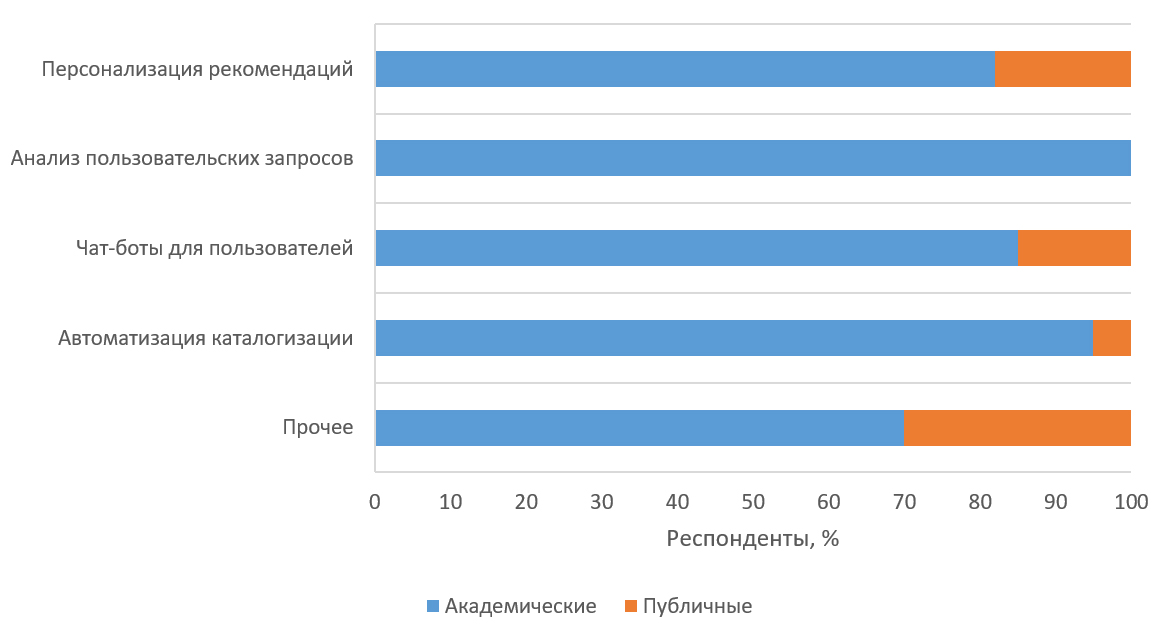
Artificial intelligence (AI) transforms information search by providing librarians with new effective tools to assist users. It changes the ways of information retrieval, where librarians play an important role in helping their users. The purpose of this article is to examine the perception of artificial intelligence by domestic librarians. Based on the analysis of publications, cases of implementation of machine learning technologies, interviews with experts and a rapid survey, the article attempts to assess the readiness to implement artificial intelligence in library practice. The results of the study show that successful integration of artificial intelligence into libraries requires the development of advanced training programs and interdisciplinary cooperation. Implementation of these measures will enable the development of library digital transformation strategies, allowing them to maintain their key role in ensuring equitable and inclusive access to information and fostering AI-literacy.
SCIENCE IN FIGURES
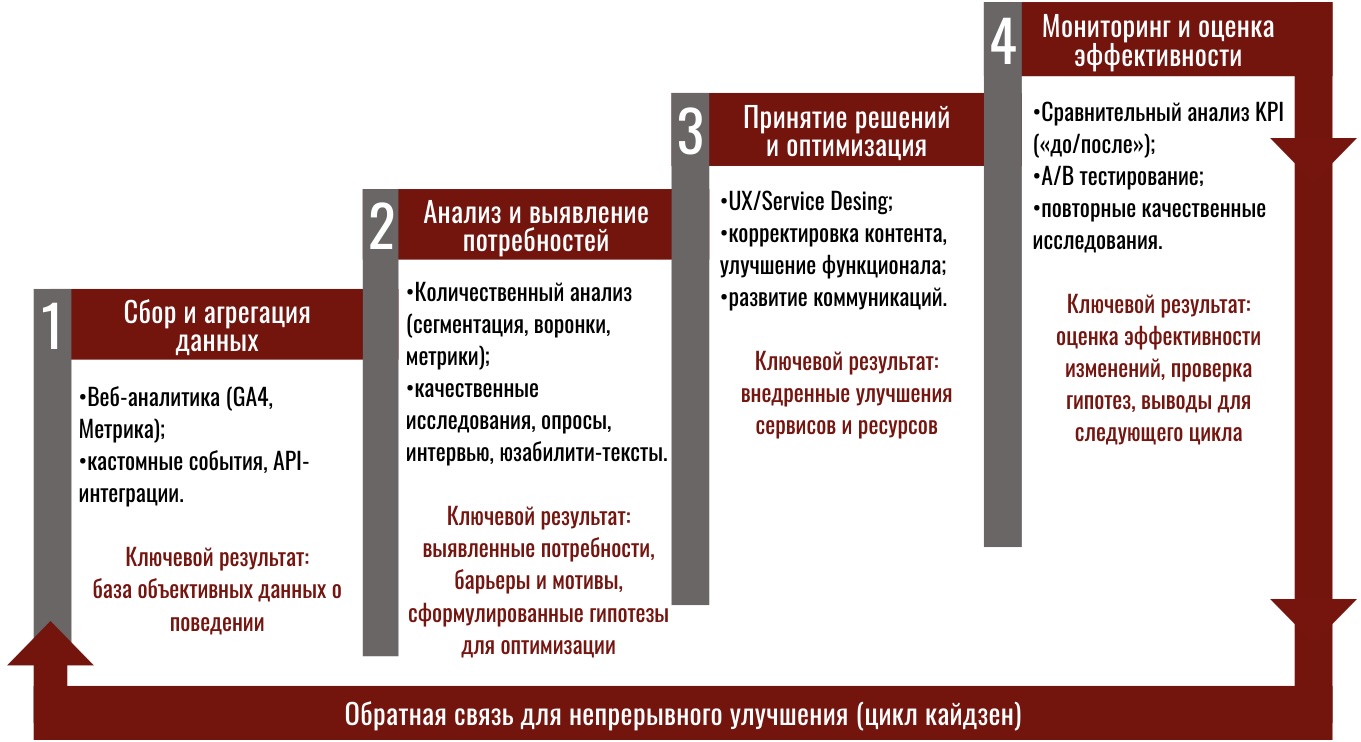
The article is devoted to the current challenges facing scientific libraries in the context of digitalization and high competition. The aim of the study is to develop and methodologically justify the cyclical model for synthesizing quantitative and qualitative data to overcome the interpretive gap in web analytics. It analyzes the problem of the interpretation gap that arises when relying solely on quantitative data from web analytics, which do not reveal the motives and deep information needs of users. As a solution, the author’s cyclical model is proposed, based on the system integration of quantitative web analytics data (the answer to the question “what?”) and qualitative research methods, such as surveys and usability testing (the answer to the question “why?”). The model is presented as a four-stage management framework (data collection, analysis, optimization, evaluation) for the continuous improvement of digital services. The main results are the creation of a holistic methodology that allows libraries the motion from analyzing actions to a deep understanding of users, as well as presenting a specific framework for its practical implementation. The use of the model allows one the transformation of a library into an adaptive ecosystem that effectively meets the complex information needs of the scientific community.
OVERVIEWS
The article presents a comprehensive analysis of the historical development and current state of science communication in Japan. It examines key stages in the evolution of this type of communication – from the postwar “Public Understanding of Science and Technology” model, which focused on fostering citizen understanding and support for science and technology, to more modern dialogic and interactive approaches that involve active public participation in the discussion of scientific and technological issues, known as the “Public Engagement in Science and Technology Model”. Particular attention is paid to the influence of government policy, cultural traditions, and major social crises, particularly the 2011 Fukushima Daiichi nuclear power plant accident, which marked a turning point in rethinking the role of science in society and sparked a surge in bottom-up initiatives. Key institutional initiatives are examined, such as the creation of the Japan Science Foundation, the launch of Science and Technology Week, the opening of the Miraikan Museum, the Science Agora forum, and the development of science café. It shows how Japan, while maintaining respect for scientific expertise and traditional values, is gradually integrating elements of open dialogue, digital formats, and civic participation into its scientific communication system. The Japanese experience is viewed as the unique example of a harmonious combination of high technology, government regulation, and cultural specificity, making it relevant for other countries, including Russia, striving for sustainable and trusting interactions between science and society in the face of modern challenges.

The development of modern society directly depends on effective science communication, which affects all social institutions, cultural practices and economic processes. Its important function is to provide society with reliable scientific knowledge, which contributes to improving the level of education, the formation of a scientific worldview and an adequate assessment of the achievements of science and technology. On the other hand, the processes taking place in society – in the political, socio-e conomic, and technological spheres – determine the conditions for the development of science communication and the dissemination of scientific knowledge among the general population. The unique challenges typical of any state determine the level of development of science communication. For example, in Brazil, in conditions of social inequality and geographical extent that limit access to scientific infrastructure for different segments of the population, science communication has its own specifics, for example: high-quality scientific education and the latest research are available to privileged strata. Brazil’s vast territory and uneven distribution of scientific centers create natural barriers to information exchange, etc. In light of these problems, public libraries can serve as a bridge between the science community and the public, traditionally acting as intermediaries between recorded knowledge and society.
The article is a review, which describes the development of science communication in Brazil, as well as ways to spread scientific knowledge in the country. Special attention is paid to the participation of libraries in science communication. The review is based on publications selected in the scientific information social network ResearchGate and the database Lens.org, and the study of the websites of public libraries in Brazil. An analysis of publications and websites has shown that today the experience of Brazilian libraries participating in science communication activities is not great, and the their main goal in popularizing scientific knowledge is to overcome information inequality and create inclusive access to scientific knowledge for all groups of the population. The library serves as an intermediary, an auxiliary tool, a place and a platform for implementing communication practices.
ARTICLES

ISSN 2712-7931 (Online)


